The man identified in court as A.G. says he was approximately eleven to thirteen when he lived at Miracle Meadows, a Christian boarding school near Salem, West Virginia, around 1999 and 2000. In his 2025 complaint, A.G. describes repeated confinement, including one period lasting about three months, as well as an incident in which an employee handcuffed him. He alleges that Jonathan Grullon sexually assaulted him during purported cavity searches, including occasions following attempts to escape. His complaint also says staff offered to reduce his confinement in exchange for sexual acts.1
I keep returning to the years between the state's 1999 removals and the school's eventual closure, particularly because A.G. places his attendance during the same period as the first investigation, although that overlap does not establish that investigators knew about the abuse he now describes. More than a decade later, according to their separate complaint, L.B. and T.B. arrived at a school where the treatment of children had already brought state officials before the courts, and they too described confinement and abuse.123
In December 1990, the Columbia Union Visitor published a favorable profile by Ruth Wright, identified as the communication director of the Seventh-day Adventist Church's Mountain View Conference. Under a headline presenting Miracle Meadows as a place saving “throwaway kids,” the article described the school as self-supporting and identified Randall Murphy, then president of the Mountain View Conference, as chair of its volunteer board. It described assistance from Adventist-laymen's Services and Industries, known as ASI, and other supporters toward buildings and equipment.4
What the state had already heard
The Associated Press reported that West Virginia's Department of Health and Human Resources had sought a residential-child-care licensing requirement for Miracle Meadows in 1994, after reports of physical and emotional abuse. According to the AP account, a circuit court concluded that requiring a license would be a decision for the legislature, leaving the state's regulatory authority over the facility in dispute several years before the investigation that eventually reached West Virginia's highest court.5
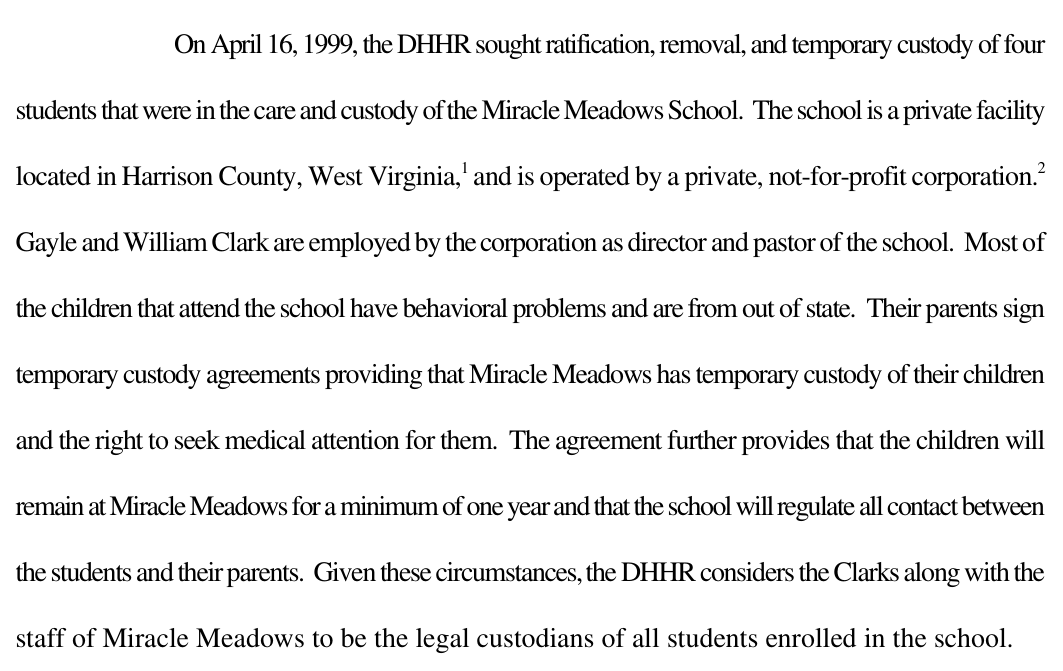
The West Virginia Supreme Court of Appeals' 2000 opinion describes temporary-custody agreements requiring children to stay at Miracle Meadows for at least a year and allowing the school to regulate all contact with their parents. Its account of the investigation begins with two girls who reported sexual abuse after running away in April 1999. After the school reported that the girls had recanted, investigators returned and heard from the girls that staff had pressured them to withdraw their allegations, after which DHHR took both into temporary custody.2
The agency also alleged that Christopher B. had been confined overnight in a secured five-foot-by-five-foot space and forced to sleep on the floor with a space heater. The agency further alleged that Aaron E. had been beaten with a board by the staff member accused of sexually abusing the girls, and officials removed both boys while the investigation into conditions at the school continued.2
The court upheld restrictions on obtaining other pupils' school and medical records without probable cause relating to those children. It recognized the agency's investigative duty and right to interview, but concluded that the interviews already conducted gave investigators sufficient opportunity and declined to compel further interviews on that record. In resolving the dispute over investigative access, the court made no finding that the school was free of abuse or that the underlying accounts were unfounded.2
By October 2007, Miracle Meadows was advertising for teachers and dormitory staff in Southern Tidings, describing itself as an expanding ministry and promising prospective workers “Guaranteed changed lives.”6
An Associated Press review of state records, published in November 2014, reported thirteen formal complaints about Miracle Meadows since 2009, including four involving sexual misconduct. Assistant prosecutor Patricia Dettori described difficulties substantiating complaints when children left or recanted and when staff from overseas departed.5
The State Police annual report records an investigation on August 14, 2014 that led to employee Timothy Arrington's arrest and emergency custody of nineteen students, ages nine to seventeen. It says the school closed as a result of the investigation.7 On August 19, the state Education Department revoked the school's state education exemption. An agency spokesperson told MetroNews that the school had submitted the annual testing information required under that exemption. Compliance with that educational filing requirement had coexisted with the events then under investigation.8
On August 22, prosecutor Joe Shaffer said eight of the nineteen children removed had been returned to the custody of the school's director, Susan Gayle Clark, and were again taken into state custody. By November 6, corporate president Kingsley Whitsett told AP that the school was permanently closed and being prepared for sale.910

On February 12, 2016, Clark pleaded guilty to three misdemeanors involving child neglect, failure to report and obstruction. Reporting from the plea hearing, Matt Harvey described Clark's admissions that she had failed to fire an employee following the improper handcuffing of a student, had reported a sexual-abuse incident after the required forty-eight-hour deadline, and had lied to an investigator about where children were located.11
At sentencing, the defense presented witnesses who credited Clark with helping students or their families, while the prosecution sought incarceration. On April 15, Judge Thomas Bedell sentenced her to six months in jail and five years of probation. The probation conditions included a prohibition on contact with unrelated children under eighteen.1213
Boys arriving from another program
In their complaint filed in Kanawha County on January 27, 2017, L.B. and T.B. said both had attended Advent Home in Tennessee before being transferred to Miracle Meadows, where L.B. placed his attendance in 2013–2014 and T.B. placed his in 2012–2014.3
L.B. described a confinement lasting approximately a month and a half, while T.B. described one lasting approximately a month and said staff had handcuffed him to a bed for two days. Both say Miracle Meadows staff, including Arrington, sexually abused them after they had already experienced abuse at Advent Home.3
In its February 2017 response, Mountain View Conference denied that the church owned, funded or controlled Miracle Meadows and also denied that it had been aware of abuse before the 2014 police investigation.14
ASI, the supporting organization named in the 1990 profile, listed $15,000 for staff housing at Miracle Meadows in its 2012 projects. Its 2013 list designated $30,000 for separate accommodation for younger children, explaining that those ages six to twelve were sharing a dormitory with adolescents. Both project descriptions appeared in ASI materials presented to supporters during the years that L.B. and T.B. say they attended Miracle Meadows.31516
The same 2012 list designated $40,000 for water-supply work at Advent Home, although the published project listings establish only the intended support and do not confirm that either school received the money or that construction was completed. The listings place both schools within ASI's published project portfolio, while the 1990 profile identifies a conference president's individual role on the Miracle Meadows board, connections whose legal significance remains contested in the survivors' cases.414151617
According to Associated Press reporting, twenty-nine former students settled a case for approximately $52 million in 2020, while a separate case involving thirty-two plaintiffs settled for about $50 million, as reported by AP in August 2023.18
A February 2026 lawsuit filed in Vermont concerns reimbursement among insurers, with Gencon Insurance Company of Vermont alleging that Adventist Risk Management settled claims involving 177 former students for $86,694,000 and seeking approximately $55.44 million from Lexington and Westport for costs Gencon contends those reinsurers are obligated to cover.19
Gencon distinguishes claims involving Adventist insureds from the school's separately defended claims and says it did not know the school's settlement terms. Because Gencon distinguishes those claims and says it did not know the school's settlement terms, its figures cannot establish a combined settlement total, and its reimbursement demand concerns the allocation of costs among insurers. An October 6 docket entry extended the deadlines for papers associated with a discovery dispute.1920
Miracle Meadows School Inc. reported in its final Form 990 for the year ending June 2022 that its property had been sold in July 2021 and the corporation's closure completed. Its supplemental schedule attributes the use of sale proceeds to debts and unpaid back wages, providing the school's own account of its corporate winding up, which remains distinct from the later claims brought against denominational institutions.2122
The rules proposed in West Virginia
The history of Miracle Meadows remained before West Virginia lawmakers in 2025, when West Virginia Watch reported on proposals arising from the cases, including Senate Bill 817, a measure that would have required covered residential programs to obtain a license. Its committee substitute proposed limits on physical discipline and required access to confidential family video calls, subject to legal or court restrictions. It also excluded organizations and residential schools operating as adjunct ministries of churches from its definition of a covered program. Its final recorded action was a referral to the Senate Judiciary Committee on March 21, 2025, and committee chair Mike Stuart subsequently told West Virginia Watch that objections from religious-program leaders, together with insufficient time, had stalled the proposal.232425
In February 2026, House Bill 5085 revived the licensing proposal with protections that included required rules for reporting restraint or seclusion within one business day and access to a telephone connected to the state's child-abuse hotline at all hours for enrolled children. The proposal would also have permitted parents to remove their children from licensed programs, while retaining the exclusion for qualifying church-adjunct ministries alongside other statutory exclusions. The official legislative history records referral of House Bill 5085 to the House Health and Human Resources Committee on February 3, with no subsequent action, meaning neither of the licensing measures described here became law.2627
House Bill 3516, considered in 2025, addressed the time survivors would have to sue defendants covered by the state's risk-management insurance program. As reported out of committee, it would have excluded those defendants from the longer filing periods for childhood sexual-abuse claims and removed the provision reviving older claims. House Speaker Roger Hanshaw told West Virginia Watch that the state's insurance liabilities and rising rates were behind the proposal. The House calendar placed the bill at third reading on April 3 without recording passage, and the current West Virginia statute continues to retain the longer filing periods and the provision reviving older claims.23282930
The cases that reached Maryland
A.G.'s Maryland case asserts responsibility against the North American Division of Seventh-Day Adventists, Columbia Union Conference of Seventh-Day Adventist and Columbia Union Conference Association of Seventh Day Adventists, Inc. Although Miracle Meadows itself is not named as a defendant in A.G.'s Maryland case, he and other former students are pursuing claims whose timing and geographic reach have become contested legal questions before their underlying allegations can be resolved.117
His complaint says the defendants supplied staff, including college interns, and helped pay some pupils' tuition and travel expenses. He further alleges that children were required to perform at Adventist churches in Maryland to promote the program, and he offers those asserted connections in support of his claim that the named institutions exercised authority over the school and bear responsibility for what happened there.1
On July 31, 2026, U.S. District Judge Brendan Hurson issued a joint opinion covering twelve individual cases. The opinion recounts reports of sexual abuse, including I.H.'s account of being raped by a staff member. The court dismissed Mountain View Conference on personal-jurisdiction grounds, a ruling concerning Maryland's authority to hear claims against that particular defendant that left the underlying accounts of abuse undecided.17
The remaining defendants' dismissal motions were denied without prejudice while the court sought an answer about Maryland's Child Victims Act. After proposing a question for Maryland's highest court and inviting the parties to recommend changes, the federal court formally certified the question on August 27, according to A.G.'s public federal docket, and stayed his case pending an answer.1731
The remaining denominational defendants argued that the Act does not cover abuse occurring wholly outside Maryland. As recounted in the July opinion, the defendants relied on Maryland's usual presumption against applying statutes beyond state borders and on their interpretation of legislative intent, while the plaintiffs argued that the Act contains no such territorial restriction and that conduct attributed to institutions in Maryland had enabled abuse in West Virginia.17
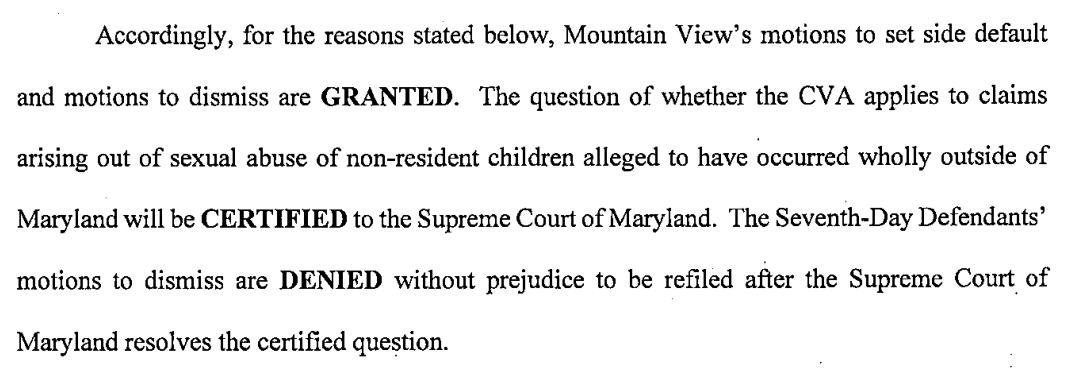
The Supreme Court of Maryland is being asked how far the state's 2023 Child Victims Act reaches, after the law removed filing deadlines for childhood sexual-abuse claims. The question in A.G.'s case assumes that Maryland's filing-deadline law applies, then asks whether the Act covers plaintiffs who were abused outside Maryland and were not Maryland residents then or now, when they sue Maryland entities alleged to be responsible as principals of the perpetrators.1732
As of October 25, 2026, the state court's public list still showed the certified question pending without an argument or opinion date, while A.G.'s federal case remained stayed as the state court considered its answer.3132
The school and the proceedings
Showing 10 events
- State seeks custody of four childrenThe later appellate opinion records that West Virginia’s child-protection agency sought ratification, removal and temporary custody of four Miracle Meadows students on April 16.Read the court’s account, printed page 2 ↗
- Court affirms limits on broader investigative accessThe court recognized the agency’s interview authority but declined further compelled interviews on the record before it. It required probable cause for other pupils’ records. The ruling did not determine that the school was free of abuse. The opinion was filed December 12 and released December 13.Read the West Virginia opinion ↗
- Nineteen children taken into emergency custodyThe State Police annual report records an August 14 investigation, Timothy Arrington’s arrest and emergency custody of nineteen students ages nine to seventeen. The agency says the school closed as a result of that investigation.Read the agency’s annual report, page 12 ↗
- Clark sentenced after guilty pleasContemporary reporting describes misdemeanor child-neglect, failure-to-report and obstruction convictions and the court’s sentence.Read the sentencing report ↗
- Settlement finalized for 29 former studentsThe State Journal reported that plaintiffs’ counsel announced $51.9 million for 29 former students, finalized October 27, 2020.Read the 2020 newspaper report ↗
- Settlement for 32 plaintiffs reportedOn August 23, Associated Press reported a settlement of about $50 million for 32 former students, separate from the 2020 settlement for 29. This is the reporting date.Read the Associated Press report ↗
- Senate licensing proposal referred to JudiciaryThe official history records Senate Bill 817’s committee substitute as reported and referred to the Judiciary Committee on March 21. This was the bill’s last recorded action. The proposal did not become law.Read the official SB 817 history ↗
- House licensing proposal introduced and referredHouse Bill 5085 was introduced on February 3 and referred to the Health and Human Resources Committee. No later action appears in its official history. The proposal did not become law.Read the official HB 5085 history ↗
- Federal court proposes a Maryland-law questionThe court dismissed Mountain View for lack of personal jurisdiction and denied the other defendants’ dismissal motions without prejudice. It proposed a question for Maryland’s highest court and invited the parties’ suggested wording.Read the federal opinion ↗
- Question formally certified; federal case stayedThe public A.G. docket lists the August 27 certification order at ECF 48 and the stay pending resolution of the question at ECF 49.Read the public docket entries ↗
Each timeline entry links to its supporting source, and the descriptions distinguish settlements from findings on disputed claims and judicial rulings from unresolved allegations. The licensing bills listed in this timeline remained legislative proposals and did not become law.