

Strauss Zelnick sits at the top of one of the biggest companies in video games. He is the chief executive and executive chairman of Take-Two Interactive, whose businesses include Rockstar Games, 2K and Zynga, and Rockstar publishes Grand Theft Auto. The man who accused him of sexual harassment appears publicly only as Doe, so his name is not part of the record available here. What is public is a legal trail showing that Doe’s allegations entered a California lawsuit, moved into an arbitration fight that had begun as a business dispute, and became harder to follow as the case filled with companies, contracts and arguments over who had to answer where.
Public summaries of Doe’s amended complaint describe conduct that would be invasive and humiliating for any person to recount. He is reported to have said that Zelnick repeatedly invited him to shower, entered or appeared in a bathroom while he was showering, stared at his naked body, exposed or disrobed himself around him, sent partially nude images and made sexual overtures. The same summaries describe threats and retaliation after he rejected those advances, including a September 2022 FaceTime call in which Doe says Zelnick warned that “bad things could happen” if he did not comply. No public merits judgment available as of publication has decided whether Zelnick committed the conduct Doe described, so the allegations remain contested even as the filings confirm that sexual harassment became a formal part of the case.
The California claims
On September 17, 2024, a First Amended Complaint in Los Angeles Superior Court added two sexual-harassment causes of action involving Zelnick. One claim was pleaded under California Civil Code sections 51.9 and 52, while another was pleaded under California Government Code section 12940 and related provisions. A First Amended Complaint is simply a revised version of a lawsuit, and a cause of action is the legal claim a party asks a court to recognize. The public court record establishes that Doe’s sexual-harassment claims were actually pleaded, which separates the existence of the complaint from the separate question of whether a judge or arbitrator has ever ruled on the truth of the conduct he described.
Los Angeles Superior Court record identifying the amended complaint
The public ruling identifies the September 17, 2024 First Amended Complaint and the two sexual-harassment causes of action. It confirms the claims were pleaded and does not decide whether the alleged conduct occurred.
The full filed complaint has still not surfaced in the publicly accessible material used for publication, which leaves the detailed allegations dependent on public summaries rather than a complete copy of the pleading itself. That gap requires care with the wording, yet it does not make Doe disappear. The public court record confirms the sexual-harassment causes, and later court-filed arbitration correspondence uses the phrase “sexual harassment claim” directly. The legal system continued to carry his allegation forward even as the public-facing record became more difficult to see.
The Harvard Club message
A separate part of Doe’s reported account points to the Harvard Club of New York City, a private Manhattan club associated with Harvard alumni. A public reproduction of language attributed to the amended complaint says Doe received a message from a Club board member who told him that the hotel-room and nudity conduct he described was “identical to complaints from other members.” The underlying message has not been published in the source material available here, and no separate complaint from another member has been independently verified. The public evidence still supports one formal complainant, while the reported board-member statement remains a specific lead that raises a larger question about what the Club may have been told before or after Doe came forward.
“identical to complaints from other members”
The reproduced language is attributed to Doe’s amended complaint. It has not been authenticated against the complete filed pleading, and it is not being used as a verified count of additional complainants.
For Doe, a statement like that would change the way his own experience looked. A man who had been trying to make sense of conduct he says happened to him would suddenly be hearing that other members may have described something similar. The Club had a Board of Trustees, an Executive Committee and a formal member-discipline process, and unrelated New York litigation documents a Board recommendation and member hearing in another dispute. Those institutional records do not show that the Club investigated Zelnick or disciplined him, but they show that the Club had a structure capable of receiving complaints, creating records and taking member action.
The Harvard Club in Zelnick’s professional world
The Club also appears in Zelnick’s public professional life. A 2018 Men’s Health profile described him organizing an early-morning workout there with three men in their 30s, and Zelnick told the magazine that when people are sweating, “all barriers drop quickly.” Public interviews with the founders of Players’ Lounge describe another route through the same setting. Zach Dixon said he spent roughly six months joining Zelnick’s Harvard Club workouts before getting a real opportunity to pitch his company, after which Zelnick became an adviser and investor.
Nothing in those accounts says Zelnick harassed the Players’ Lounge founders, and the workouts cannot be treated as corroboration of Doe’s allegations. They do show that the Club was part of an environment where personal familiarity with a powerful executive could become professional access. The institution named in Doe’s reported account therefore sits inside a documented social and professional network rather than appearing as an incidental location. A board member’s reported reference to other complaints would have occurred inside an organization that already had formal governance and member-discipline mechanisms.
Men’s Health on Zelnick’s exercise routine, professional relationship-building and Harvard Club workout.
Open source ↗ Founder interviewFront Office Sports on the Players’ Lounge founders and months of Harvard Club workouts before the pitch.
Open source ↗Harvard Club of New York City venue material
The Club’s own PDF shows the Manhattan institution discussed in the reporting. It provides setting and institutional context rather than evidence of misconduct.

What Take-Two had on paper
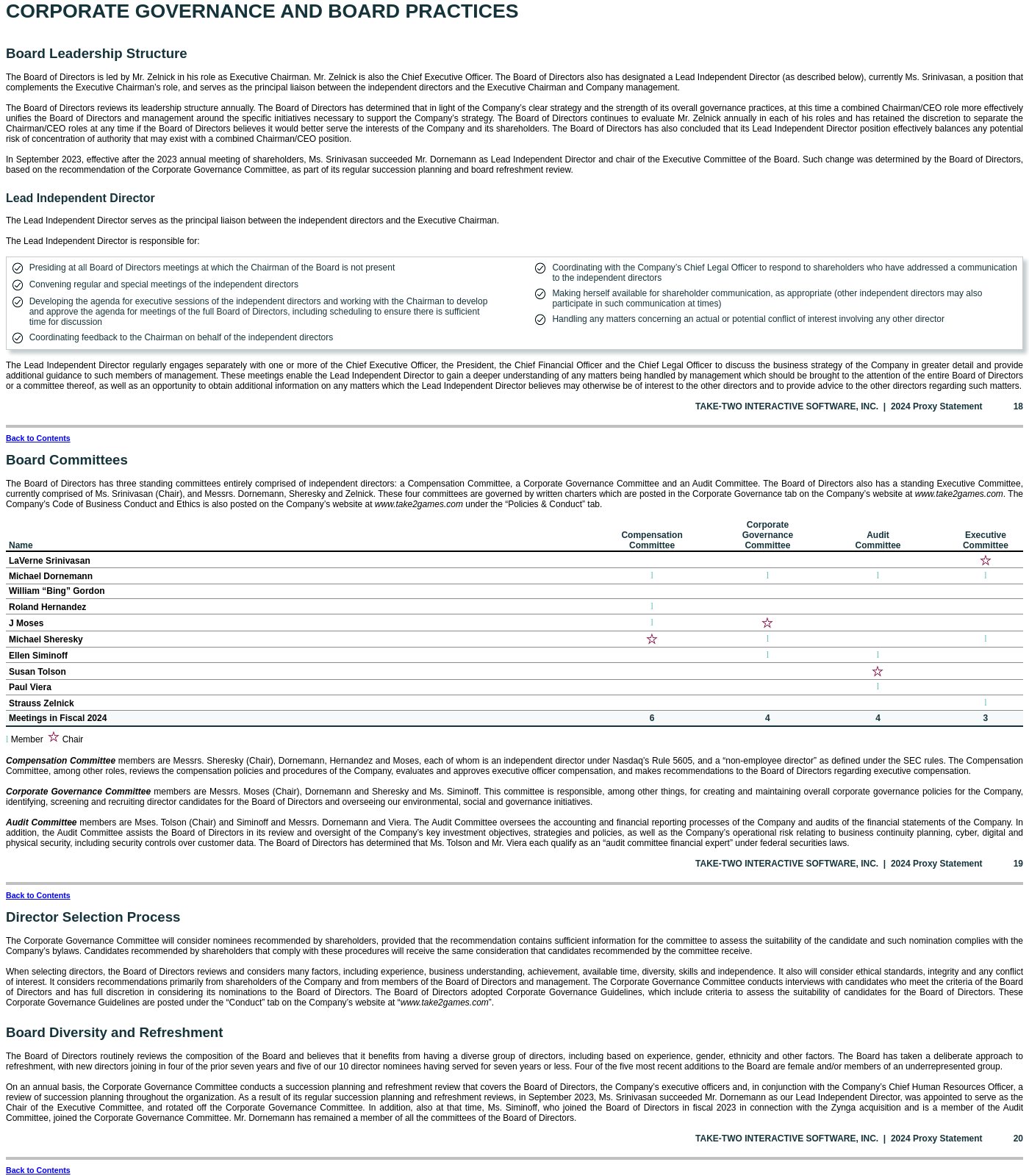
Take-Two faced a different institutional question since Zelnick was not a lower-level employee whose conduct could simply be referred upward through ordinary management. He was the chief executive and board chair, which placed him at the very top of the corporate structure. Take-Two’s July 2024 proxy statement, filed several weeks before Doe’s claims were added to the California case, identified LaVerne Srinivasan as Lead Independent Director and assigned that role responsibility for issues involving an actual or potential conflict of interest concerning another director. The same filing described independent Board committees and executive sessions held without management present.
The company’s governance documents show that those independent channels already existed before Doe’s sexual-harassment claims entered the lawsuit. Take-Two’s 2025 proxy continued to describe independent executive sessions and recurring review of Zelnick, other senior executives and the company’s relationship with ZelnickMedia, while Zelnick remained in leadership and was reelected as a director. Public filings do not identify Doe’s allegation as the subject of a Board review, which leaves the central institutional question unanswered. The available documents show that independent oversight mechanisms existed, yet they do not reveal whether Doe’s complaint ever reached them.
Take-Two’s 2024 proxy statement
The company’s own filing describes the Lead Independent Director role, independent Board committees and executive sessions. These structures existed before Doe’s claims entered the California case.
Take-Two’s April 2026 Global Code of Business Conduct and Ethics says complaints are to be handled promptly and that potential wrongdoing will be investigated, with results potentially reported to the Board or an appropriate committee. That later policy cannot tell us what happened inside the company after Doe’s 2024 allegations surfaced. It does show that Take-Two publicly describes formal channels for handling serious concerns involving directors and officers. For a man accusing the company’s most powerful executive of sexual harassment, whether his allegation ever entered one of those channels is a basic question the public filings still do not answer.
The claim moved into arbitration
The arbitration grew out of an earlier business dispute involving Steven Marks and several related entities. The parties were already fighting over an LLC agreement before Doe’s sexual-harassment claims entered the California case, so the private proceeding did not begin as a harassment case. Arbitration is a private process used to resolve disputes outside an ordinary public trial, usually under a contract that sends specified disagreements to an arbitrator instead of a judge or jury. In February 2025, the California court stayed the public action while arbitration moved forward, shifting the dispute into a process that is far harder for outsiders to follow.
The stay did not decide whether Doe’s account was true. The parties then fought over who was bound by the arbitration agreement, which entities had actually signed it, and how much authority the arbitrator had over people and companies that said they were not parties to the agreement. Court-filed exhibits show participation in arbitrator selection and briefing alongside continuing objections about arbitrability and nonsignatory status. Those mechanics explain how a man’s sexual-harassment claim could become wrapped inside pages of contract law and disputes among business entities that had little to do with the intimate conduct he said he experienced.
“sexual harassment claim”
A September 2025 email filed as an exhibit in the New York Article 75 proceeding referred directly to a “sexual harassment claim.” The filing shows that the harassment issue had entered the arbitration process and does not decide whether the alleged conduct occurred.
The Marks side later went to New York court through an Article 75 proceeding, the part of New York law used when a court is asked to intervene in an arbitration dispute. Their petition invoked the federal Ending Forced Arbitration of Sexual Assault and Sexual Harassment Act, which can allow people bringing certain sexual-assault or sexual-harassment disputes to reject forced arbitration. The New York docket later marked the proceeding “Decided” and the case “Disposed,” but the publicly available labels do not reveal who prevailed or what reasoning the court used. No public final merits judgment available as of publication decides whether Zelnick committed the conduct Doe reported.
Zelnick’s defense
Zelnick’s side describes the wider business conflict as bitter and escalating. In a sworn declaration filed in support of a later sanctions motion, he said he received what he called a “graphic and disturbing voicemail” from Marks and portrayed that episode as part of a failed business relationship that had become increasingly hostile. The declaration is relevant to the atmosphere surrounding the litigation and to the credibility fight between the business adversaries. It remains Zelnick’s sworn account of later conduct in that dispute rather than a judicial finding about Doe’s earlier harassment allegations.
“graphic and disturbing voicemail”
Zelnick used this phrase in a declaration filed in support of a sanctions motion. The declaration describes later hostility in the business conflict and does not resolve Doe’s harassment account.
The hostility surrounding Marks cannot stand in for an answer to what Doe says happened between him and Zelnick. Doe’s account concerns unwanted sexual conduct and later retaliation, while the declaration concerns a later episode in a business fight involving Marks. Treating one as an automatic answer to the other would erase the man whose complaint brought sexual harassment into the case in the first place. The two parts of the record can be reported together without collapsing them into the same question.
Second City, YHS and the Wexner money trail
Separate financial records place Zelnick inside Second City Capital Partners I, a private investment fund. A 2004 Form D filed with the Securities and Exchange Commission identifies him as an executive officer and director, while the same filing lists The C.O.U.Q. Foundation and YHS LLC in the beneficial-owner section. The filing reported $53.75 million sold or irrevocably committed from 28 accredited investors, including two investors in the U.S. Virgin Islands accounting for a combined $30 million. Those entries document Zelnick’s formal role and the fund’s disclosed investor structure at that time.
Later JPMorgan due-diligence material identifies Jeffrey Epstein as the sole beneficial owner of YHS LLC. Epstein was the convicted sex offender and financier whose financial relationship with Leslie Wexner later became the subject of extensive public scrutiny and litigation. Separate tax records show substantial Wexner-family-linked funding of C.O.U.Q., while the Wexner Foundation’s independent review records the Wexners’ position that certain transfers involving Epstein were unauthorized or misappropriated and that later asset returns represented recovered assets. The paper trail places Epstein-linked and Wexner-family-linked entities inside the same fund where Zelnick held a formal management role, while leaving unanswered what Zelnick personally knew about the ultimate owners or source of those assets.
The filing identifies Strauss Zelnick as an executive officer and director of Second City Capital Partners I and lists C.O.U.Q. Foundation and YHS LLC in the beneficial-owner section.
Open filing ↗ Filed court material · public mirrorJPMorgan due-diligence material identifies Jeffrey Epstein as the sole beneficial owner of YHS LLC.
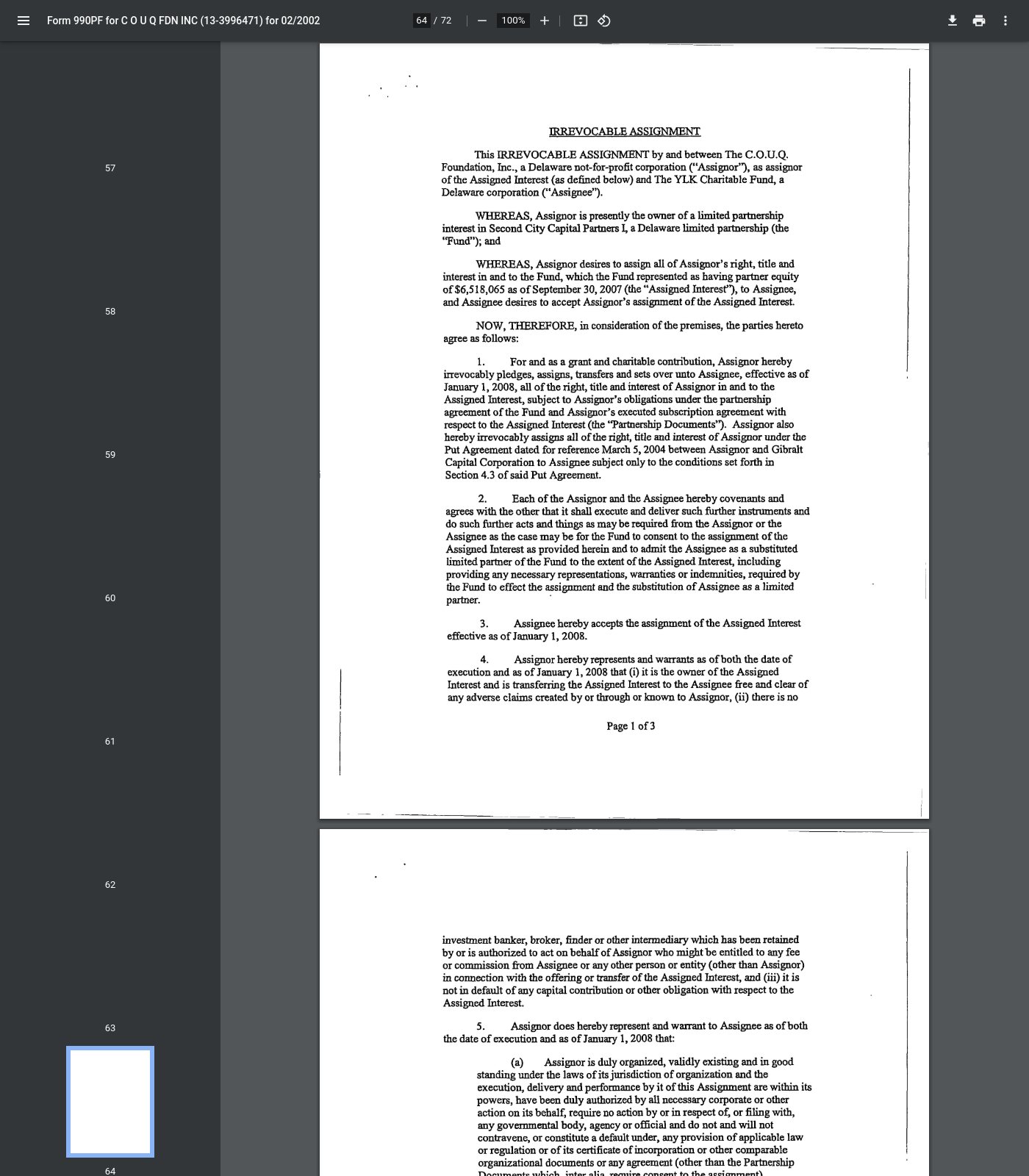
Open record ↗The Second City interest moved through Wexner-linked charitable entities
The publicly hosted document copy includes the transfer of C.O.U.Q.’s Second City interest to YLK. The transfer record forms part of the financial chain and is separate from the sexual-harassment allegations.
The financial record has limits that are just as important as the connections it documents. No public source used here establishes that Zelnick knew Epstein was the person behind YHS, that he discussed Second City with Epstein, or that he knew the ultimate source of C.O.U.Q.’s assets. The fund records also do not prove Doe’s harassment allegations. They show the scale and character of the financial world around Zelnick, which is useful context for understanding the power imbalance surrounding a complainant who entered the dispute without anything close to the same institutional reach.
Sources used in this report
Los Angeles Superior Court ruling · public summary of the amended complaint · Men’s Health profile · Front Office Sports interview.
Take-Two 2024 proxy · New York Article 75 docket · Zelnick declaration · Second City Capital Partners I Form D.