
By August 1973, Everett Waldrop had spent more than two years not knowing where two of his sons were. Donald was fifteen and Jerry was thirteen when they disappeared together in Houston on January 30, 1971, after their father dropped them off to see a friend. Everett gave police names, possible leads, and whatever else he had while he kept waiting for the boys to come home. Then police began recovering the bodies of boys and young men from burial sites connected to Dean Corll, and Donald and Jerry were identified among them. After those identifications, Everett said publicly that Houston police had not taken the disappearances seriously enough, while police officials answered that juvenile officers were already handling thousands of missing and runaway reports.
The Corll story usually begins after everyone knows there was a killer, which changes the way every earlier warning looks. For more than two years, Donald and Jerry were simply two missing sons whose father was trying to get people to understand that something was wrong. Houston police were working inside a flood of runaway and missing-youth reports, while Everett was living inside one case involving his own children. I am keeping a careful line here because the records do not show that every Corll victim was formally classified as a runaway. Some boys were never reported missing, and some families believed their sons had left voluntarily, but the volume of runaway cases clearly shaped how missing teenagers were being processed when the Waldrops disappeared.
Congress put part of that problem into federal law during 1974, when the Runaway Youth Act acknowledged that the country did not even have adequate national information about runaway children. Police and juvenile-justice agencies had been carrying much of the responsibility for finding, holding, and returning those young people, even when the reasons they left home were more complicated than a delinquency file could show. The new law funded community programs that could provide temporary shelter and counseling outside those systems. It did not change every local practice at once, and it did not declare that every runaway child had been abused. It did give the federal government a way to treat a young person who left home as someone who might need care before anyone decided what kind of problem the child was.
That same year, the Child Abuse Prevention and Treatment Act put sexual abuse directly inside the federal definition of child abuse and neglect. Every state already had some form of child-abuse reporting law by the end of the sixties, so this was an expansion of an existing system rather than the beginning of one. CAPTA tied federal support to reporting procedures, investigations, protection, training, and coordination between agencies that were supposed to respond when children were being harmed. Earlier records involving boys had often preserved the adult's criminal charge, the boy's behavior, or a psychiatric description more clearly than the sexual harm itself. The new federal framework gave child-protection agencies clearer language for abuse that had often been scattered across other kinds of records.
Then there is an eight-year-old boy whose name never appears in the published Utah opinion that preserved what happened to him. During 1974, a ride operator at the Utah State Fair offered him passes, took him to a truck, and sexually assaulted him. The boy told his father that evening, and his parents took him back to the fair with police so he could identify the man. A medical examination supported the boy's account, and the Utah Supreme Court later upheld the conviction under an aggravated-sexual-assault statute that had been amended the year before. His name disappeared from the published decision, but his disclosure did not get translated into delinquency, homosexuality, or some other explanation before the system treated it as sexual violence against a child.
A few states were also rewriting laws that had literally been built around female victims. Michigan replaced its older rape structure with a criminal-sexual-conduct code written around offenses against another person, and that change took effect in 1975. Two years later, a fifteen-year-old boy was the complainant in People v. Poteat after accusing a thirty-five-year-old man of sexual assault. The appellate court reversed the conviction because the trial judge improperly used the boy's religious background when assessing his credibility, although the court did not question whether a male teenager could be covered by the statute. Another Michigan case reached the state supreme court after a teacher was charged with sexual conduct involving a ten-year-old male student, and the teacher was later acquitted, so the published case cannot be used as proof of the allegation. Maine was changing on its own schedule, and a 1978 decision there openly compared an older law protecting girls with a newer code protecting any person under fourteen.
Federal crime statistics were still using a different language while those state laws were changing. The FBI's Uniform Crime Reporting definition of forcible rape continued to count a female victim, leaving male victims outside the national rape category even when a state sexual-assault law could recognize them. A boy could therefore exist in a police file as the complainant in a sexual-assault case and still disappear from the federal rape total used to describe crime across the country. That gap changed the picture agencies showed the public because male victims could be present in police files without appearing in the national number used to describe rape. Part II followed the older labels attached to boys, and the seventies added new labels without clearing the old ones out of every system.
A child-protection system could also have the right language and still leave a boy where he was being hurt. A Minnesota Supreme Court opinion written in 1982 describes a boy placed in a Hennepin County foster home in November 1976 even though the county welfare department had already received a molestation complaint involving another foster child in that home. According to the later court record, the boy was sexually abused during the next fifteen months and was removed after the foster father was arrested on criminal-sexual-conduct charges involving other foster children. Because the opinion was written years later, I am using it for what it documents about the placement rather than pretending it gives us a perfect account of what every official knew at every moment. The file already contained a warning, and the boy was still placed in the home where the later abuse occurred.
The language around homosexuality was shifting during the same years, although law, medicine, and daily life were moving at different speeds. In 1973, the American Psychiatric Association removed homosexuality itself from the Diagnostic and Statistical Manual as a mental disorder, while a replacement diagnosis called sexual orientation disturbance remained for people distressed by their homosexuality. Clinicians who had trained under the earlier model did not lose those assumptions overnight, and criminal law was still capable of treating consensual sex between adult men as an offense. Virginia's sodomy law survived a federal constitutional challenge involving private consensual sex between adult men, and the Supreme Court summarily affirmed that judgment in 1976. A gay man could read that psychiatry no longer classified homosexuality itself as a disorder and still live under a state law that criminalized the conduct associated with it.
Houston's gay press was already pushing back against the way those ideas were being mixed together after the Corll murders. In the January-February 1974 issue of The Nuntius & Our Community, readers objected to local coverage that called the crimes a "homosexual murder ring" or described them as "homosexual murders." The victims were boys who had been sexually assaulted and killed, yet the public language around their deaths kept pulling homosexuality into the explanation. Gay writers were arguing in real time that violence against children should not be used as a description of adult sexual orientation. That argument was happening while psychiatry was revising its own language, which shows how much cultural baggage remained even after a diagnostic label changed.
Medical writing from the decade carries that baggage directly onto the page. A 1976 psychiatric case report described a father initiating sexual encounters with his son, while the authors interpreted the father through a period theory of "latent homosexuality." The boy's abuse was visible in the report, but the explanation still pulled attention toward a theory about the adult man's sexuality. Two years later, another article described ten sons across six families involving fathers or stepfathers and placed father-son incest inside the broader subject of child abuse. That was a small clinical series and cannot tell us how common the abuse was, although it shows physicians beginning to write about sons as abused children rather than only as evidence inside a theory about the father.
Researchers were also beginning to hear from men whose childhood abuse had never produced a criminal file. David Finkelhor's 1978 study asked college students about childhood sexual victimization and found male histories alongside female histories across six Northeastern colleges. The sample was limited and retrospective, so I am not turning its male percentage into a national estimate. What the study captured was something police statistics could easily miss because men were describing childhood experiences whether or not a report, prosecution, medical examination, or child-welfare case had ever existed. A congressional research paper published that same year also challenged the professional assumption that boys represented only a very small share of child victims and reviewed evidence that male victimization was being underreported.
Rape-crisis services were becoming far more visible during these years, but the movement grew from women organizing against the neglect and mistreatment of female rape victims. A 1972 manual from the Washington, D.C., Rape Crisis Center repeatedly described women helping women and built much of its training around female victims. A federally sponsored review published in 1977 also described community sexual-assault services in women-centered terms while documenting advocates entering hospitals, police departments, prosecutors' offices, and crisis programs. I cannot use those sources to say every rape-crisis center refused boys or men, and later records show male clients receiving help in at least some programs. A boy or man looking for language about what had happened to him could still see a rapidly expanding service system whose public language rarely sounded as though it had been written with him in mind.
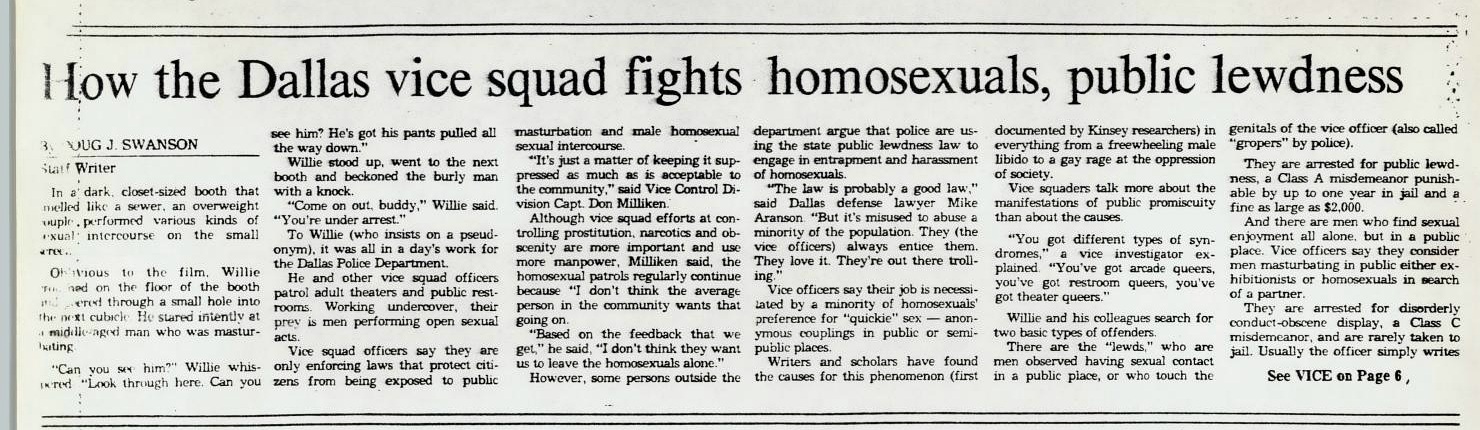
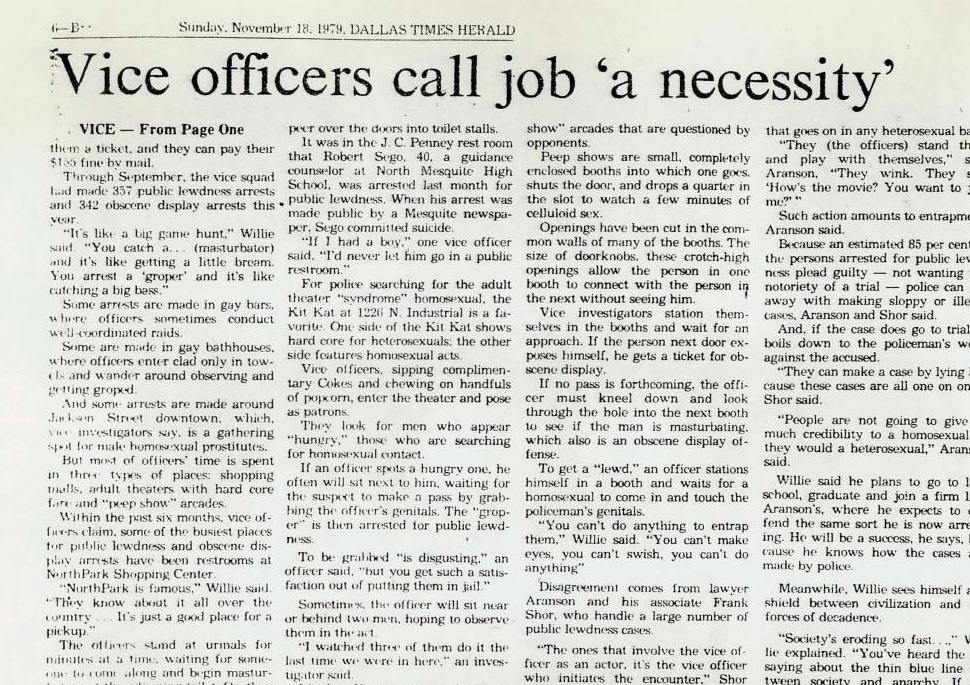
Gay men had another reason to be cautious about police contact because vice enforcement remained aggressive in public and sexual spaces. A Dallas Times Herald article from November 1979 described vice officers working in adult theaters, restrooms, parks, gay bars, and other public places while making public-lewdness arrests. Defense lawyers quoted in the article accused officers of initiating encounters and using tactics they described as entrapment, while police defended the operations as necessary enforcement. The same decade that produced new clinical language for male sexual-assault victims still had police units watching men for same-sex sexual conduct in places associated with gay life. A man deciding whether to tell authorities about sexual violence was making that decision inside the same legal culture that could also treat his consensual sexuality as suspicious or criminal.
By 1979, the phrase "male rape victim" appeared plainly in the title of an American emergency-medicine article. The author wrote that medical literature offered little guidance, criticized the sexual bias in existing rape laws, and discussed children and adolescents as a large part of the male patient population seen after sexual assault. Federal law-enforcement writing was also speaking more directly about sexually exploited boys, including an FBI Law Enforcement Bulletin article drawing heavily on the Detroit Police Department Sex Crime Unit. That article described boys between nine and fourteen as a major population in the child pornography and prostitution activity being discussed and told adults to respond calmly, compassionately, and without placing guilt on the child. Its observations came from Detroit, so I am keeping them in that setting rather than stretching them into a national count. The language put the child on the victim side of exploitation instead of leaving him inside labels such as prostitution, delinquency, or running away.
By the time the seventies ended, a boy could enter a sexual-assault case, a child-protection file, a medical article, or a research study under language that had barely been available to him a decade earlier. The same boy could still move through another institution as a runaway, a delinquent, a participant in prostitution, or a problem inside somebody else's theory about homosexuality. A foster-care file could contain a warning and still fail the child, while a police department could recognize one boy as a sexual-assault complainant and count another kind of male victim outside the national rape statistics. Those records never settle into one clean story because the institutions were not agreeing with one another about what they were seeing. They carry the boys into the eighties with newer words on the books and older habits still deciding how those words were used.